A Cultural Shift Away From "More"
If parenting in 2025 felt like trying to keep up with TikTok, your group chat, your kid's school portal, and the price of groceries all at once—you weren't alone. The relentless pressure to have every gadget, enroll in every activity, and maintain an Instagram-perfect nursery left parents exhausted and children overstimulated.
But something is changing. Across social media feeds and in living rooms around the world, parents are quietly retiring the chaos. The parenting trends of 2026 are calmer, simpler, more budget-aware, and a lot more realistic about what families actually need to thrive.
Welcome to the minimalist parenting movement.
What Is Minimalist Parenting?
Minimalist parenting isn't about owning nothing or depriving children of joy. At its core, it's about reducing mental load and prioritizing connection over consumption. It's a philosophy that asks: What do we actually need versus what are we told we need?
The term gained significant traction in 2013 when Christine Koh and Asha Dornfest wrote Minimalist Parenting, advocating for less stuff, less scheduling, and fewer interventions in a child's life. Their approach dovetailed naturally with the broader minimalism movement popularized by Marie Kondo's 2014 bestseller The Life-Changing Magic of Tidying Up.
But minimalist parenting goes beyond decluttering closets. It extends to:
-
Physical stuff
Fewer toys, streamlined wardrobes, intentional purchases -
Schedule clutter
Saying no to overscheduled activities and constant commitments -
Mental clutter
Reducing decision fatigue and the pressure to be "perfect" -
Digital clutter
Setting boundaries with screens and social media comparison
The Historical Roots & How We Got Here
The Rise of Helicopter Parenting
To understand minimalist parenting, we need to understand what it's responding to. The term "helicopter parent" first appeared in Dr. Haim Ginott's 1969 book Between Parent & Teenager, where teenagers described their hovering parents using the helicopter metaphor.
The helicopter parenting phenomenon accelerated dramatically in the 1990s, coinciding with two major shifts: a booming economy that gave families more disposable income to spend on children, and an increased public perception of child endangerment—a perception that free-range parenting advocate Lenore Skenazy has described as "rooted in paranoia."
By the early 2000s, helicopter parenting had become the dominant cultural expectation. Parents scheduled every minute of their children's days, protected them from any possibility of failure, and often continued advocating for them well into college and even the workplace.
The Counter-Movement - Free-Range Kids
In 2008, Lenore Skenazy sparked a national conversation when she wrote a column about letting her 9-year-old son ride the New York subway alone. The response was polarizing—some called her "America's Worst Mom" while others praised her for giving children the independence previous generations had enjoyed.
Her subsequent book, Free-Range Kids, and nonprofit organization Let Grow became figureheads for a counter-movement emphasizing childhood independence. This wasn't about neglect; it was about recognizing that children are resilient and that overprotection creates its own risks.
Research supports this perspective. According to Dr. Peter Gray, a research professor at Boston College, over the past 50 years we've seen an eight-fold increase in depression and a five-to-ten-fold increase in generalized anxiety disorder among children—correlating closely with the decline in children's freedom to play unsupervised.
Marie Kondo & the Tidying Revolution
The minimalism movement got a significant boost when Marie Kondo's methods went mainstream through her 2019 Netflix series Tidying Up with Marie Kondo. Her philosophy of keeping only items that "spark joy" resonated with overwhelmed parents drowning in baby gear and children's toys.
But in 2023, Kondo made headlines for a different reason: she admitted that after having three children, she had "kind of given up" on achieving total tidiness. Rather than undermining minimalism, this revelation humanized the movement. Kondo shifted her focus to kurashi—a Japanese concept meaning "way of life" or "the ideal way of spending our time."
This evolution perfectly captures where minimalist parenting is heading in 2026: not rigid perfectionism, but intentional imperfection. Not empty rooms, but functional spaces that allow for more quality time with family.
The Burnout Crisis Driving Change Today
Parents Are Exhausted
The minimalist parenting movement isn't just a lifestyle trend—it's a response to a genuine crisis. Recent research from The Ohio State University paints a sobering picture:
- 57-65% of parents self-report experiencing burnout
- Parental burnout is strongly associated with both internal and external expectations—including whether one feels they are a "good parent" and perceived judgment from others
- Higher levels of parental burnout correlate with more mental health problems in children
- The pressure to be "perfect" leads to unhealthy impacts on both parents and children
"I think social media has just really tipped the scales," explains Dr. Kate Gawlik, one of the study's lead researchers. "You can look at people on Instagram and always think, 'How do they do that?'"
The pandemic amplified these pressures exponentially. Parents juggled remote work with homeschooling, faced unpredictable childcare availability, and performed at expected professional levels while managing household chaos. Many emerged determined to never return to that level of overwhelm.
The Solution: Doing Less, Better
The data reveals something important: more free play time with children and lighter loads of structured extracurricular activities correlate with fewer mental health issues for both parents and kids. The culture of achievement that creates burnout can be actively countered by embracing simplicity.
This isn't about being lazy or uninvolved. It's about recognizing that presence matters more than perfection, and that children don't need a constant stream of activities, toys, and stimulation to thrive.
What Minimalist Parents Are Actually Doing in 2026
Rethinking Baby Gear
The baby products industry has long convinced new parents that they need an overwhelming array of gadgets and gear. Minimalist parents are pushing back with a radical question: What does a baby actually need?
The answer is surprisingly simple: a safe place to sleep, a way to be fed, clothing to be comfortable, and love. Everything else is optional.
Parents embracing minimalism report focusing on:
- Multi-functional items: Convertible cribs that become toddler beds, diaper bags that double as everyday bags
- Quality over quantity: Investing in fewer, better-made items rather than accumulating cheap products that break or go unused
- Second-hand shopping: Babies grow so quickly that consignment stores, Facebook Marketplace, and hand-me-downs from friends make both financial and environmental sense
- Renting instead of buying: Premium baby gear rental services allow families to use quality items without permanent purchases
One mother who worked as the Editorial Director for Marie Kondo describes her approach: "I live by the motto 'fewer, better.' Because I chose to bring fewer items into my home, I was willing to invest in them. This made me take the time to do research: How long will this last me? Does it serve multiple purposes? Is it an essential or a nice-to-have?"
Practical Tools That Actually Help
Not all baby gear is unnecessary. Minimalist parents have identified certain items that genuinely simplify daily life:
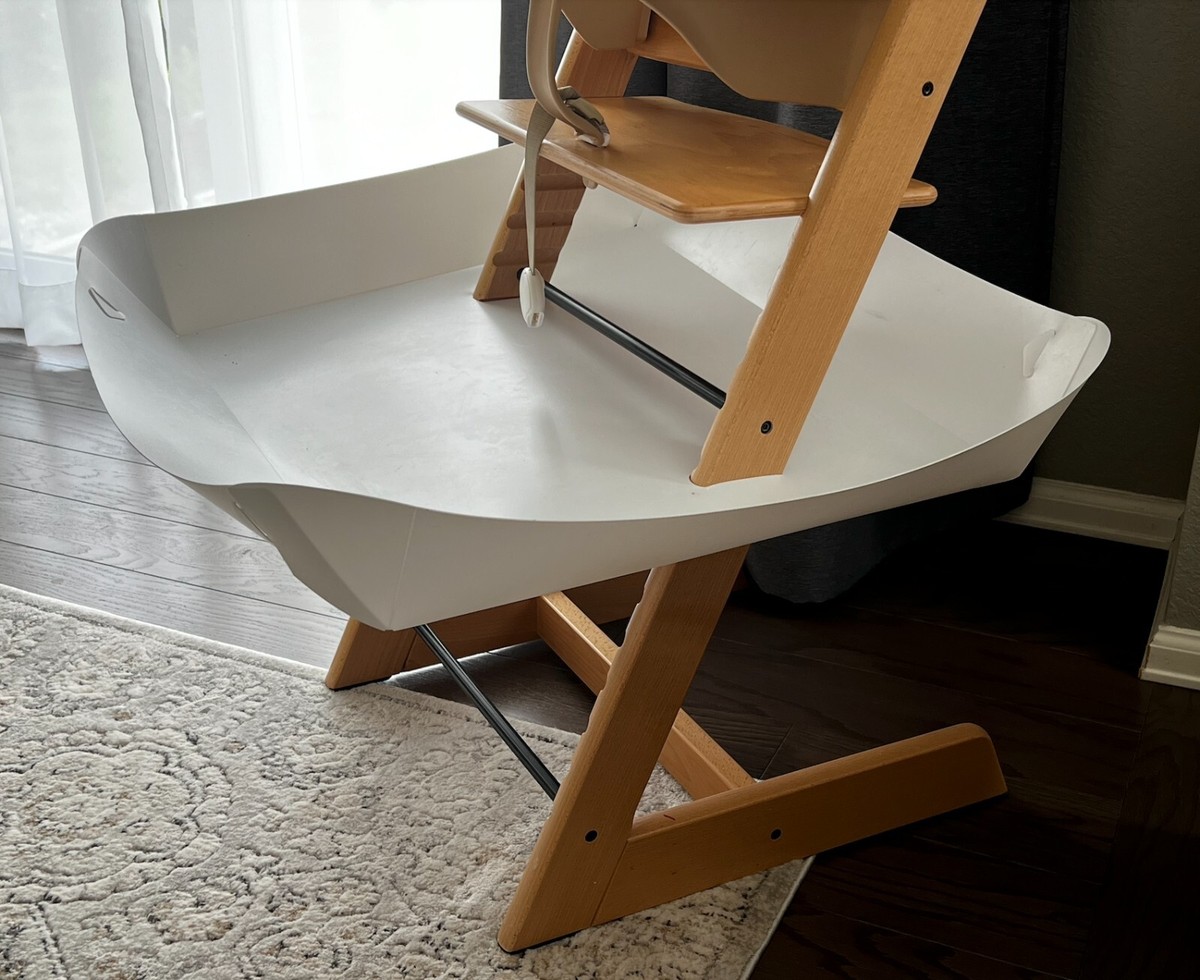
The Catchy (High Chair Tray): A large tray that straps onto a high chair to catch dropped food. It prevents parents from being on their hands and knees after every meal and allows them to save clean food that hasn't touched the floor.
Built-in Features in Clothing: Onesies with built-in mittens and footsies eliminate the need to track (and lose) small accessories. Fewer pieces mean less laundry and less searching for matching items.
Microwave Sterilizers: A time-saving alternative to boiling pots of water for bottle and pump parts, reducing daily workload significantly.
Allergen Starter Kits: Specialized kits help parents safely and systematically introduce common allergens when babies start solids, turning a potentially overwhelming process into a structured one.
Under-Bed Storage Bags: Rather than random boxes, organizing clothes and gear by developmental stage makes it easy to store or retrieve items—essential for families planning future children.
The Capsule Wardrobe Approach
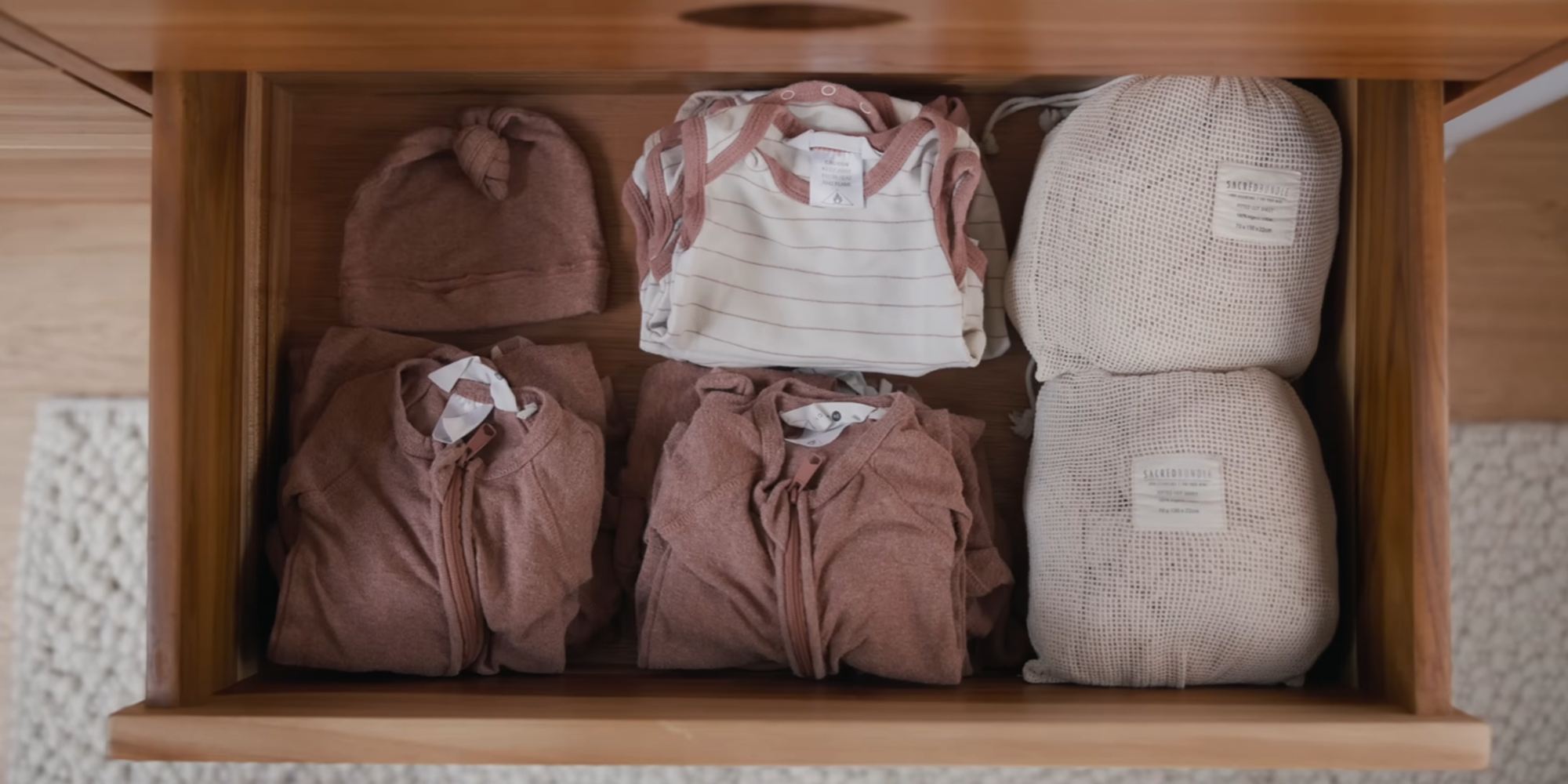
One of the most practical minimalist strategies is the baby capsule wardrobe. Instead of closets overflowing with rarely-worn outfits, parents curate 15-20 core pieces that mix and match easily.
The benefits are significant:
- Decision fatigue elimination: Any combination works, making morning routines faster
- Reduced laundry: Fewer items means less washing, folding, and organizing
- Financial savings: Buying fewer, quality pieces costs less than accumulating cheap items
- Environmental impact: Less consumption means less textile waste
- Calmer nursery spaces: Less clutter creates a more peaceful environment
The approach works because babies grow so rapidly that most clothing gets worn only a handful of times regardless of how much you own. Parents report that their partners can dress the baby without guidance because everything coordinates.
The One-In, One-Out Toy Rule
Perhaps no aspect of parenting accumulates clutter faster than toys. Birthday parties, holidays, well-meaning grandparents, and impulse purchases can quickly overwhelm any home.
Minimalist parents address this with a simple boundary: the "one-bin rule." Once the designated toy storage is full, a toy must be donated or removed before a new one can be added. This keeps clutter from expanding beyond a manageable footprint.
Research supports this approach. When children are surrounded by too many toys, they exhibit:
- Shorter attention spans, jumping from toy to toy
- Difficulty focusing and making decisions
- Reduced creativity and imaginative play
- More stress and overwhelm
Studies show that children actually play longer and more creatively with fewer toys. The brain's response to excess is similar to having too many browser tabs open—overwhelming and unfocused.
Toy Rotation takes this further: keeping only 5-10 toys accessible at a time while storing the rest out of sight. Every few weeks, parents rotate the selection. Children get excited about "new" toys that feel fresh, while total quantity stays manageable.
Key principles for toy decluttering include:
- Open-ended over closed-ended toys: Blocks, art supplies, and costumes can be played with many ways; electronic toys with single functions often get abandoned quickly
- Quality over quantity: Fewer well-made toys outlast many cheap ones
- Experiences over possessions: Time at the park, family walks, reading together, and creative play provide more developmental value than more stuff
Managing External Gift-Givers
One of the biggest challenges minimalist parents face is managing the "avalanche" of external stuff—particularly gifts from grandparents and family members who express love through purchases.
Successful strategies include:
- Having organic conversations about preferences before gift-giving occasions
- Suggesting alternatives: Experience gifts (museum memberships, swim lessons), contributions to college funds, or consumable items like art supplies
- The single book keepsake: Instead of multiple toys, one family uses a large children's book where every guest writes a note—creating a meaningful, space-saving memento
- Framing it positively: Explaining that you want to create calm spaces for the child, not criticizing gift-giving impulses
Simplifying Schedules
Physical minimalism is only part of the equation. The 2026 parenting movement extends to schedule clutter—the overscheduled activities that leave families exhausted.
Parents are actively retiring:
- Every-night-of-the-week activities
- Pressure to participate in every enrichment opportunity
- The assumption that busy children are thriving children
They're replacing this with:
- Unstructured free time: Boredom, backyard play, board games, and park days
- Present parenting: Fewer commitments mean more actual time together
- Split-shift parenting: One parent focusing on children while the other works, does chores, or takes care of themselves
The Broader Philosophy: Connection Over Consumption
What 2026 Trends Tell Us
The parenting trends emerging in 2026 reveal a cultural shift toward sustainability—both environmental and emotional:
What's OUT:
- Overscheduled kids
- Instagram-perfect everything
- Extreme "never say no" parenting that lost sight of healthy boundaries
- Inchstone parties and themed snack boards made for social media
What's IN:
- Boundaries with empathy ("I get how you feel" plus "Here's the limit")
- Slow, "analog" childhood with more unstructured time
- Hand-me-downs and support that beats expensive aesthetics
- Mental health as health—therapy, honest conversations, and getting help when needed
- Hybrid parenting approaches that blend different styles based on what actually works
The Gen Z Parenting Revolution
Interestingly, the oldest members of Gen Z are now becoming parents, and they're bringing a distinct perspective. Research shows that fewer than 40% use strict gentle parenting, with the vast majority preferring a blend of different styles personalized to their families.
They're characterized by:
- Breaking harmful cycles passed down from previous generations
- Using technology strategically—AI to streamline routines, but limiting children's screen time
- Leaving Pinterest perfection behind
- Split-shift parenting becoming more common
- Focus on trauma healing while creating healthier patterns
As one Gen Z parent put it: "Parenting should always be loving, but sometimes that entails making a decision your child doesn't like."
Environmental Consciousness
Minimalist parenting aligns naturally with environmental values. Buying fewer items, choosing sustainable products, embracing second-hand goods, and reducing waste all benefit both the family and the planet.
Parents report choosing:
- Reusable cloth diapers over disposables
- Organic, sustainable fabrics that are gentler on baby skin and the environment
- Items that can be passed down or resold rather than discarded
- Quality wooden toys that biodegrade rather than plastic that enters landfills
The circular economy approach—buying quality second-hand, using items thoroughly, then passing them on—reduces both costs and environmental impact.
Getting Started: Practical First Steps
For parents interested in embracing minimalist principles, experts recommend starting small:
-
Audit one category: Pick toys, clothes, or baby gear and assess what's actually being used versus what's just taking up space
-
Establish boundaries before shopping: Know your limits on storage space and quantity before purchases or registries
-
Practice one-in, one-out: Make it a habit before stuff accumulates
-
Declutter regularly: Before birthdays, holidays, and each new season
-
Communicate with family: Share your preferences for experiences over stuff
-
Let go of perfection: The goal isn't a magazine-worthy home; it's a functional life that allows for presence
-
Start with yourself: Children learn by watching—declutter your own belongings first
-
Focus on experiences: Reading together, park visits, family meals, and unstructured play cost nothing and create lasting memories
Conclusion? - Less Is More
The minimalist parenting movement of 2026 isn't about deprivation or judgment. It's about recognizing that modern parents have been sold an impossible standard—one that leaves them burned out, broke, and too exhausted to enjoy the children they're trying so hard to raise well.
The research is clear: more stuff doesn't equal happier children. More activities don't equal better development. More perfection doesn't equal healthier families.
What does matter? Presence. Connection. Intentionality. Space—physical and mental—to actually enjoy these fleeting years.
As the saying goes: "If you want your children to turn out well, spend twice as much time with them and half as much money."
Perhaps the best parenting trend of 2026 is simply this: fewer things to chase, more space to actually enjoy your kids.
Sources: Research from Ohio State University, The Bump, NPR, TIME Magazine, and parenting experts including Lenore Skenazy (Let Grow), Dr. Peter Gray (Boston College), and Marie Kondo.